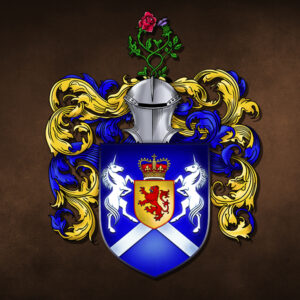
Baron de Burgund

59,90

The former County of Burgundy, known in French as Franche-Comté, is located in eastern France along the border with Switzerland. It should not be confused with the region of Bourgogne (Burgundy), which lies further west and has a different historical background.

As early as the 6th century, this region formed part of the Frankish Empire and later became part of the Kingdom of Burgundy. Following the death of King Rudolf III in 1032/1033, who left no heirs, the territory passed to the Holy Roman Empire. From then on, the County of Burgundy remained closely connected to the Empire for several centuries and played an important role as a border region between the German and French spheres of influence.

PDF-Download:
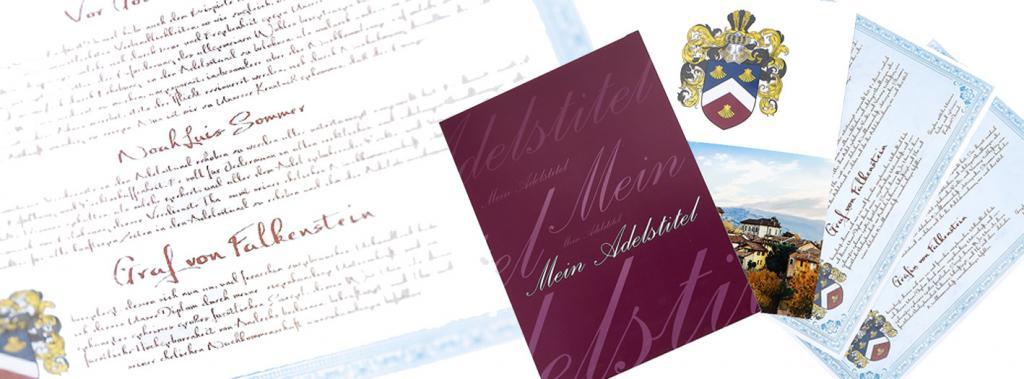
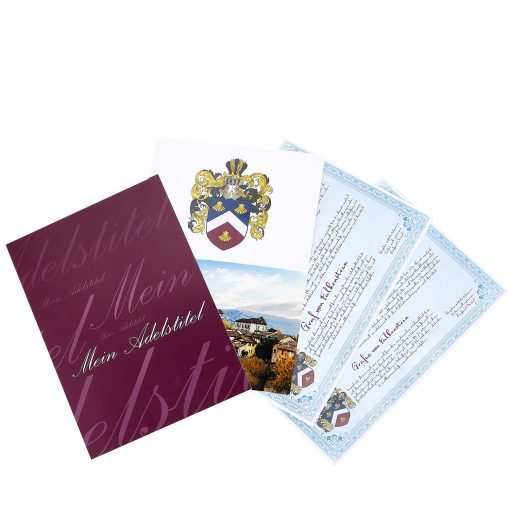
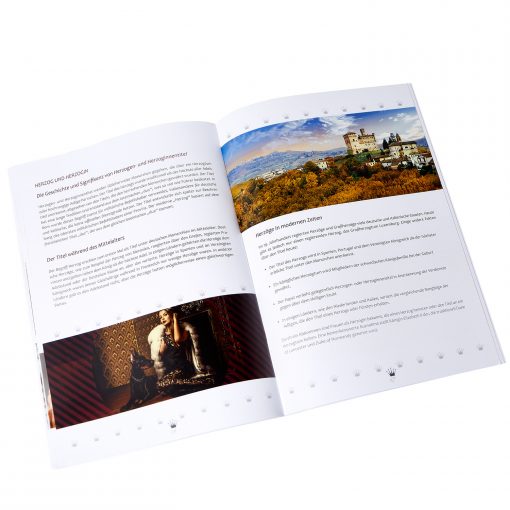
Alle Urkunden, Wappen und die Broschüre stehen sofort nach der Bestellung in Ihrem Kundenkonto zum Download bereit - jederzeit und dauerhaft. Hierfür berechnen wir nur eine geringe einmalige Gebühr.

Druck und Versand:
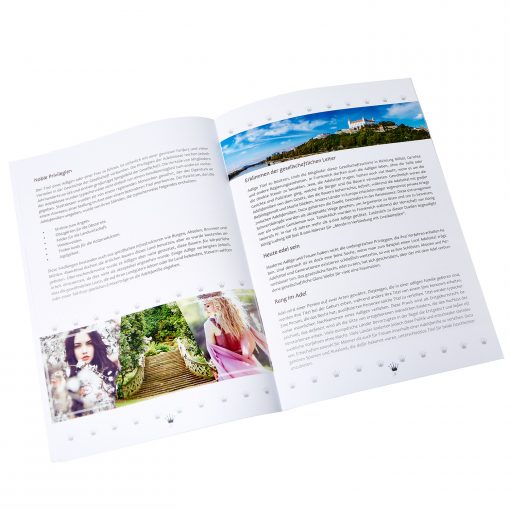
Zusätzlich zum Download erhalten Sie alle Unterlagen in gedruckter Form (Urkunden auf glänzendem Papier, Broschüre, Geschenkmappe) per DHL.

Anmerkung:
Das Zubehör wird nur angezeigt, wenn “Druck und Versand” ausgewählt ist.


Die ID Karte hat die Größe einer Visitenkarte und besteht aus Aluminium. Die Vorderseite ist goldfarben bedruckt und enthält Ihren Titel und Ihr Wappen.
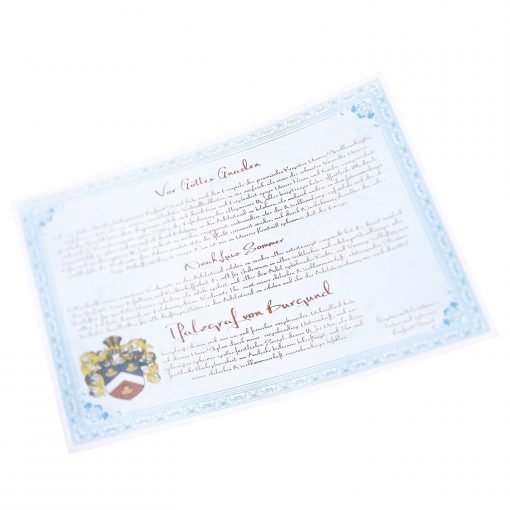
Wir bestätigen Ihre Ehrenmitgliedschaft mit einer prächtigen Urkunde. Die Mitgliedschaft ist mit keinen laufenden Kosten verbunden und bleibt mit dem einmaligen Beitrag lebenslang gültig. Wenn Sie zwei Mitgliedschaften bestellen, stellen wir die zweite Urkunde für Ihren Partner aus, der ebenfalls die Gratis-Urkunde erhält.
Auf den Münzen ist auf einer Seite der Nennwert angegeben. Bei den Silbermünzen ist dies 1 Taler, bei den Goldmünzen 10 Taler. Auf der anderen Seite ist Ihr Wappen zusammen mit Ihrem Namen und Ihrem Titel abgebildet.
Sie können wählen, ob Sie ein oder zwei Flaschen Rot- oder Weißwein mit Ihrem ganz persönlichen Etikett erhalten möchten. Das Etikett ziert Ihr Wappen sowie Ihren Titel und Namen. Zusätzlich erhalten Sie passende Weingläser, auf denen Ihr Titel, Ihr Wappen und Ihr Name eingraviert sind.
Mehrfachauswahl möglich. Alle Zubehörteile werden mit Ihrem Namen, Titel und Wappen personalisiert und dem Inhaber des Hauptzertifikats ausgestellt.

Beinhaltet den Druck Ihrer Urkunden, Wappen und Broschüren sowie die Versandkosten per DHL. Sie können Ihre Auswahl oben ändern.
Einmalige Gebühr für die Bereitstellung Ihrer Urkunden, Wappen und Broschüren zum unbegrenzten Download. Sie können Ihre Auswahl oben ändern. Das Zubehör wird nur angezeigt, wenn “Druck und Versand” ausgewählt wurde.
Artikelnummer: PA820 Kategorie: Schlagwörter: , , ,

Beschreibung

The title Count of Burgundy was first explicitly used by Otto William of Burgundy-Ivrea, marking the emergence of a distinct political authority in the region. Otto William (c. 962–1026), a member of the Anscarid dynasty, established his rule over the County of Burgundy—also known as the Free County (Franche-Comté)—which at the time lay within the sphere of the Holy Roman Empire. His assumption of the title reflected both territorial control and the growing importance of Burgundy as a strategic region between the German and French realms.

His descendant Beatrix of Burgundy (1143–1184), also known as Beatrice I, Countess Palatine of Burgundy, married Emperor Frederick I Barbarossa in 1156. Through this marriage, Barbarossa gained direct influence over Burgundy, integrating it more closely into the imperial structure. He reorganized parts of the territory and elevated them to the status of a Palatinate (Pfalzgrafschaft), thereby strengthening imperial administration. Their son, Otto I, inherited Burgundy from his mother and continued to rule as Count Palatine, maintaining the region’s importance within the Holy Roman Empire.

In 1208, Otto’s daughter Beatrix II of Burgundy married Otto I, Duke of Merania from the House of Andechs. This marriage transferred control of Burgundy to the Andechs-Meranian dynasty, significantly expanding their influence across Central Europe and into regions of present-day France and the Balkans. Under their rule, Burgundy became a key political link between different noble networks. However, the line came to an end with the death of Otto II of Andechs-Merania in 1248, marking the extinction of the male branch of this powerful house.

Following this, the County of Burgundy passed to his sister Adelaide (Adelheid), who had married Hugh of Chalon from the House of Salins. Through this union, the territory came under the control of the Salins family. Their son, Otto IV of Burgundy (1248–1303), ruled the county during a time of shifting allegiances and political instability, as Burgundy alternated between the influence of the Holy Roman Empire and the Kingdom of France.

After centuries of contested control, Burgundy was ultimately incorporated into France under King Louis XIV, the “Sun King,” in the late 17th century. Through military campaigns and political consolidation, Louis XIV secured Burgundy as part of the French crown, bringing an end to its long-standing semi-independent status and integrating it fully into the French state.
Zusätzliche Informationen

Bitte auswählen

PDF herunterladen, drucken und versenden

Bewertungen

Es gibt noch keine Bewertungen.

Schreibe die erste Bewertung für „Baron de Burgund“