





Description
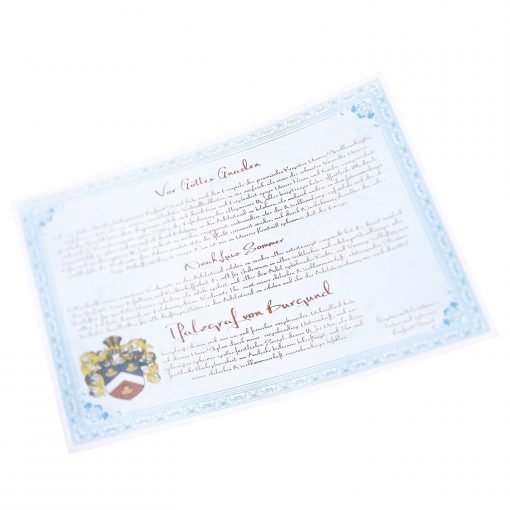
The title Count of Burgundy was first explicitly used by Otto William of Burgundy-Ivrea, marking the emergence of a distinct political authority in the region. Otto William (c. 962–1026), a member of the Anscarid dynasty, established his rule over the County of Burgundy—also known as the Free County (Franche-Comté)—which at the time lay within the sphere of the Holy Roman Empire. His assumption of the title reflected both territorial control and the growing importance of Burgundy as a strategic region between the German and French realms.
His descendant Beatrix of Burgundy (1143–1184), also known as Beatrice I, Countess Palatine of Burgundy, married Emperor Frederick I Barbarossa in 1156. Through this marriage, Barbarossa gained direct influence over Burgundy, integrating it more closely into the imperial structure. He reorganized parts of the territory and elevated them to the status of a Palatinate (Pfalzgrafschaft), thereby strengthening imperial administration. Their son, Otto I, inherited Burgundy from his mother and continued to rule as Count Palatine, maintaining the region’s importance within the Holy Roman Empire.
In 1208, Otto’s daughter Beatrix II of Burgundy married Otto I, Duke of Merania from the House of Andechs. This marriage transferred control of Burgundy to the Andechs-Meranian dynasty, significantly expanding their influence across Central Europe and into regions of present-day France and the Balkans. Under their rule, Burgundy became a key political link between different noble networks. However, the line came to an end with the death of Otto II of Andechs-Merania in 1248, marking the extinction of the male branch of this powerful house.
Following this, the County of Burgundy passed to his sister Adelaide (Adelheid), who had married Hugh of Chalon from the House of Salins. Through this union, the territory came under the control of the Salins family. Their son, Otto IV of Burgundy (1248–1303), ruled the county during a time of shifting allegiances and political instability, as Burgundy alternated between the influence of the Holy Roman Empire and the Kingdom of France.
After centuries of contested control, Burgundy was ultimately incorporated into France under King Louis XIV, the “Sun King,” in the late 17th century. Through military campaigns and political consolidation, Louis XIV secured Burgundy as part of the French crown, bringing an end to its long-standing semi-independent status and integrating it fully into the French state.
 English
  Français
  Español
  Italiano
  Deutsch
Reviews
There are no reviews yet.