




Descrizione
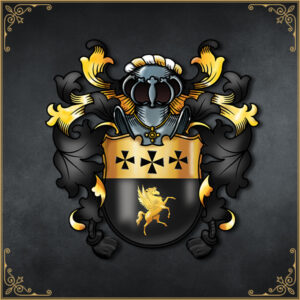
The History of Falkenstein Castle and the House of Falkenstein-Münzenberg
Falkenstein Castle on Mount Donnersberg in the Palatinate, one of the highest fortification sites in the region, was completed by 1135. Its strategic significance eventually became its downfall during the Thirty Years’ War: in 1647, French troops under General Turenne besieged and captured the fortress, subsequently demolishing the outer walls with explosives. By the time 1794 arrived and the chaos of the French Revolution swept through the Palatinate, the original lineage of Falkenstein lords had already been extinct for centuries. The ruins passed through various prestigious hands—including the Dukes of Lorraine and even the House of Habsburg—before being acquired by the municipality of Falkenstein. Since 1979, the site has undergone partial reconstruction and preservation to safeguard its cultural heritage.
Historical documentation begins in 1135, when a certain Siegebold of Falkenstein was first mentioned as the lord of the castle. The following 40 years remain shrouded in historical darkness, a period of uncertainty that only ended after 1170 when the influential Bolanden family appeared in the annals as the new lords. A decisive turning point occurred in 1233: Philipp IV of Bolanden officially began styling himself as Philipp I of Falkenstein, thereby founding the new House of Falkenstein. Under his sons, Philipp II and Werner, the lineage split into the Falkenstein-Butzbach and Falkenstein-Lich branches.
However, the power of the House of Falkenstein was by no means limited to the Palatinate. Following the extinction of the related Hagen-Münzenberg noble family in 1255—known as the “Münzenberg Inheritance”—the Falkensteins acquired vast territories in the Wetterau and the Rhine-Main region. They ascended to become one of the most powerful families in Hesse, taking control of areas like Offenbach and constructing Neufalkenstein Castle in the Taunus mountains as a formidable symbol of their expanding influence.
The Butzbach branch produced one of the most prominent figures of the Middle Ages: Kuno II of Falkenstein. As the Prince-Elector and Archbishop of Trier (1362–1388), he held one of the seven highest offices in the Holy Roman Empire, acting as a kingmaker and close advisor to Emperor Charles IV. Upon his death, he was succeeded in this powerful office by his great-nephew, Werner III of Falkenstein, from the Lich line. Werner III was a controversial and combative spirit; as the lord of Offenbach, he frequently clashed with the Free Imperial City of Frankfurt, detaining their merchants and provoking bloody feuds. With his death in 1418, the male line of the House of Falkenstein became extinct.
The massive inheritance was divided between the Lords of Eppstein and the Counts of Solms. While the Eppstein lineage also died out in the 16th century, the House of Solms survives to this day. The last surviving female of the Falkensteins is remembered as Anna of Falkenstein, Werner’s sister. She displayed a charitable side by founding a hospital in Dreieichenhain, which was later relocated to Offenbach. However, legend has it that the burdens of her foundation and the fate of her family weighed so heavily upon her that she found no peace in the grave; until the mid-19th century, she was said to haunt the walls of her former estates as a “White Lady.”
 English
  Français
  Español
  Italiano
  Deutsch
Recensioni
Ancora non ci sono recensioni.