


Descrizione
Marchese
To fulfill their duties, margraves were granted frontier territories directly by the king or emperor as fiefs. Compared to ordinary counts, margraves held extended powers: they commanded the military levy (Heerbann) and exercised high jurisdiction. They were authorized to build fortifications and were supported by a larger number of Frankish vassals. These privileges gave them considerable independence and authority as rulers of important border regions—often comparable to that of the great tribal dukes. Across the Frankish realm, capable farmers were encouraged to settle in these frontier areas, enabling margraves in some regions to raise substantial forces of their own. They exercised high judicial authority without requiring separate authorization from the king, making them key figures in maintaining order and defense along the borders.
The House of Bourbon
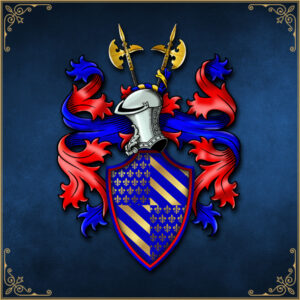
The House of Bourbon is a cadet branch of the French royal Capetian dynasty, descending from the youngest son of King Louis IX of France (Saint Louis). Ultimately, Hugh Capet, the founder of the Capetian line, is also the ancestor of the Bourbons. This lineage was reflected during the French Revolution, when King Louis XVI was referred to before the National Convention in 1792 by the civil name “Louis Capet.”
Today, the Bourbons are the last surviving male-line descendants of the Capetian dynasty. These include the Spanish line Bourbon-Anjou, with its branches Bourbon-Sicily and Bourbon-Parma, as well as the Bourbon-Orléans line with its Brazilian branch, the House of Orléans-Braganza. The Bourbons are considered the oldest still-existing royal dynasty in Europe, as all other Capetian branches—such as the House of Valois, the House of Artois, or the House of Évreux—have become extinct in the male line. The former Portuguese royal house of Braganza also descends from the Capetians, although through an illegitimate branch of the older House of Burgundy.
Bourbon-l’Archambault
The name of the dynasty originates from the castle of Bourbon (Bourbon-l’Archambault), which can be traced back to the Carolingian era. During the High Middle Ages, this castle served as the seat of a noble family that established rule over the surrounding region. The territory that developed from this, known as the Bourbonnais, came into the possession of Beatrix of Burgundy through inheritance. Beatrix, herself a member of the Capetian House of Burgundy, married Prince Robert in 1272, thereby bringing the Bourbonnais into his possession.
The family name itself resulted from a transaction by their son, Louis of Clermont. In 1327, he exchanged his paternal inheritance, the County of Clermont, with King Charles IV “the Fair” for the County of La Marche. On this occasion, the king elevated the Seigneurie of Bourbon to a duchy and granted it the hereditary dignity of a peerage (pairie). At the time, this was a unique development, as previously only the traditional duchies based on ethnic regions existed in France. The Bourbonnais thus became the principal possession of Duke Louis I and his descendants, who from then on adopted the name “de Bourbon.”
 English
  Français
  Español
  Italiano
  Deutsch
Recensioni
Ancora non ci sono recensioni.