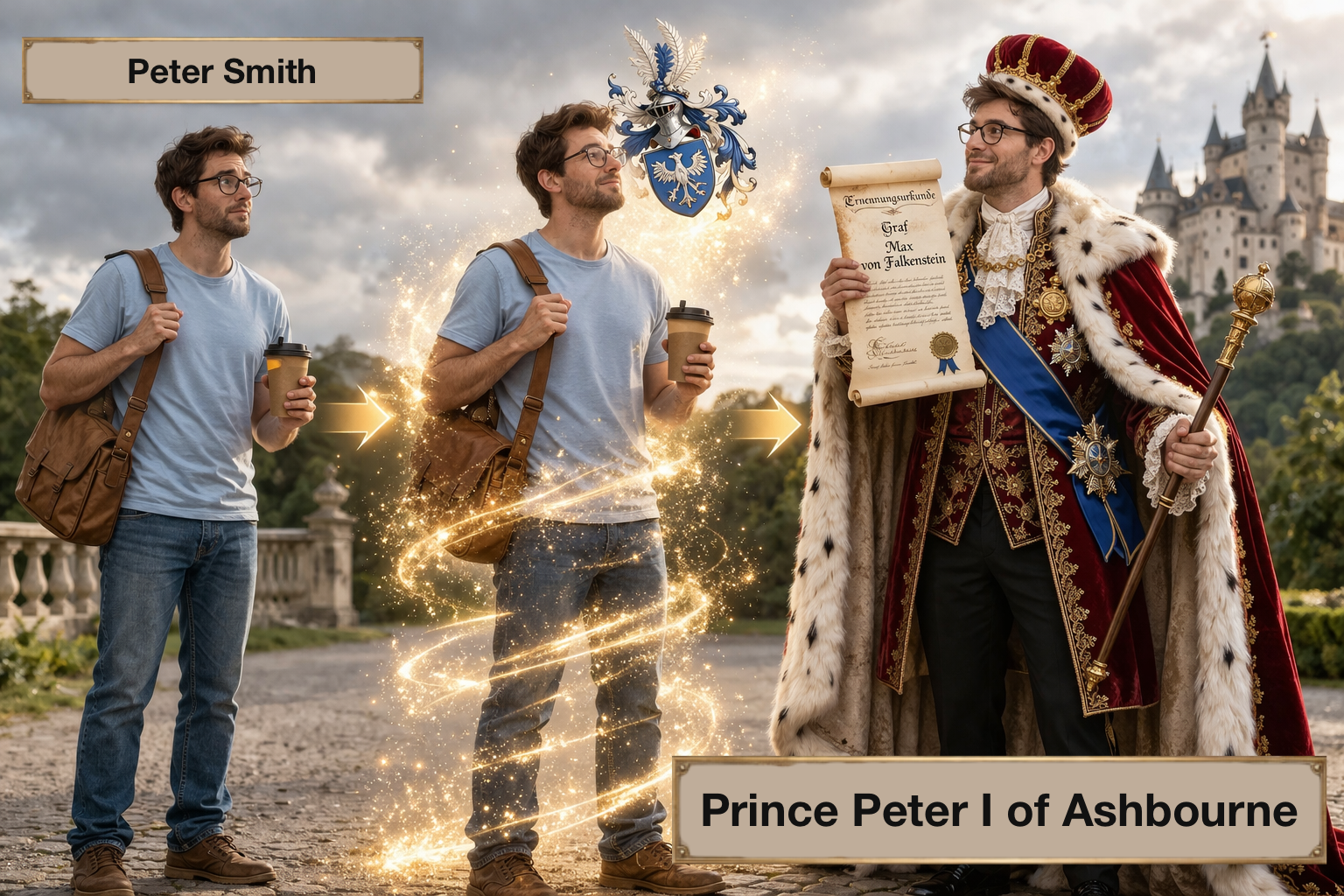



European nobility developed over centuries within a complex landscape of kingdoms and empires, evolving from early power structures into a defined social hierarchy. Originally based on land, influence, and loyalty, noble titles became symbols of rank, responsibility, and identity. While their political power declined over time, their cultural significance remained strong. Today, noble titles represent tradition, elegance, and personal expression rather than authority. Choosing to buy a noble title connects you with this rich European heritage while allowing you to shape your own identity in a modern context, combining history, style, and individuality into a distinctive and memorable presence.

The Historical Development of Nobility
The origins of nobility cannot be traced to a single, clearly defined starting point. Rather, it emerged gradually as a social principle that evolved over thousands of years across different cultures. Early civilizations such as ancient Egypt, Mesopotamia, China, Japan, and later the Roman world developed hierarchical systems that distinguished individuals by status, power, and responsibility. While these early structures laid important foundations, they were not yet identical to what we understand today as nobility or formal noble titles.
Historical accounts suggest that early societies were not always strictly hierarchical. The Roman historian Tacitus, for example, described certain communities as relatively equal, with systems of rule developing only over time. Much of what we know about early elites comes from archaeological discoveries. Richly furnished graves point to individuals of higher status, even when no formal titles were recorded. Nobility, therefore, is best understood not as a fixed origin, but as the result of continuous social development.
From Power to Structure
Over time, the concept of nobility became more defined. Across Europe and other regions, titles emerged as visible markers of rank and social order. At the same time, systems of obligation developed, often based on land ownership, loyalty, and military service. Nobility became a central element of political and social organization, shaping entire societies.
For centuries, noble status was closely tied to power. It was expressed through political authority, military responsibility, and economic influence. Land ownership played a particularly important role, as it provided both wealth and control. Noble families often maintained their position across generations, creating long-standing structures that defined regional and national systems.
At the same time, nobility was never entirely static. Throughout history, individuals could rise into the noble class through achievement, service, or recognition by rulers. This allowed the system to remain flexible and adaptive. Especially during the early Middle Ages, new forms of nobility emerged, often linked to military strength and the ability to provide protection. This led to the development of feudal systems, where titles, land, and status were closely interconnected.
Nobility in the Modern World
As societies evolved, so did the role of the nobility. What began as a primarily military-based class gradually transformed into an administrative and political elite. Nobles took on roles in governance, diplomacy, and court life, contributing to more complex and stable state structures.
With the rise of centralized states and modern political systems, many of the traditional functions of the nobility declined. By the nineteenth century, noble status was increasingly defined by heritage and tradition rather than direct political power. In the twentieth century, major historical changes led to the loss of formal privileges in many countries, and titles became largely symbolic.
Today, nobility no longer exists as a privileged legal class in most parts of Europe. However, noble titles remain highly visible and culturally significant. They continue to be associated with history, elegance, and distinction, maintaining a strong presence in both tradition and modern identity.
Nobility as a Modern Choice
In the end, nobility has always been about perception and meaning. That has not changed. What has changed is how it is expressed. Today, noble titles are less about inherited authority and more about personal identity.
More and more people choose to buy a noble title not for power, but for presence. It is about how a name sounds, how it is perceived, and how it sets you apart. A noble title becomes a conscious decision—a way to connect with centuries of tradition while shaping your own modern identity.
A noble title today is not a relic of the past, but a bridge between history and the present. It allows you to bring tradition into your everyday life, adding a sense of style, distinction, and individuality that continues to resonate.